Skip to content

For parents of children who find maths, reading or writing hard

Real understanding instead of finger counting.

Short video lessons for UK parents of children with dyscalculia, dyslexia and persistent learning difficulties. You learn the method on your own, then fifteen minutes a day together, in one sitting or scattered through the day.

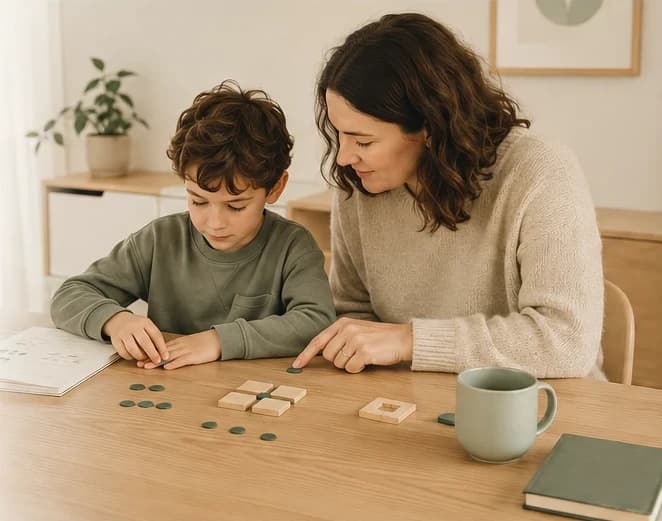
A parent and child sitting side by side at a kitchen table. The child's hands are holding the counters.
Side by side, not opposite. The counters belong to the child.

Counting, one by one

Understanding, at a glance

Fig. 1 · The same five dots. In a row, they have to be counted. As a shape, they're simply seen.

Your child simply needs different learning strategies from the ones used at school, not just more workbooks or more exercises. Because if more of the same were the answer, it would have worked by now.

Not sure where to start?

How old is your child?

A few short questions, and you can skip any of them. Nothing you choose is saved or sent anywhere.

What worries you most right now?

pick the worry that comes up most at home

Who Alderfold is for

For parents who want to help their child finally make sense of maths, reading or writing without turning every afternoon into a battle.

Every course comes in two halves, the learning half and the parent half.

Maths is open now. Dyslexia (Reading, writing, spelling) is being built.

  • Dyscalculia & maths

    From finger counting to real understanding

    For parents of children who still count on their fingers, lose number facts overnight, or dread maths homework.

  • Dyslexia: reading

    From sounding out every letter to seeing the whole word

    For parents of children who read slowly and effortfully, guess from pictures, or avoid reading aloud.

    Not open yet
  • Dyslexia: writing & spelling

    From copying out corrections to words that stay

    For parents of children whose spelling changes every time, who avoid writing, or whose ideas never reach the page.

    Not open yet
  • Parenting through learning difficulties

    From pushing harder to working alongside

    For any parent whose child struggles at school, and who is tired of evenings that end in tears on both sides.

    Comes with every course

Every course has two halves

  • The learning half

    You learn simple, effective ways to support your child in short videos. Then you bring those ideas into your child's everyday world and use what your child already loves. No abstract worksheets. No endless repetition. Instead, learning becomes playful, meaningful and connected to what your child actually cares about. Just up to 15 minutes a day, whenever it fits. Small, meaningful moments of learning so your child can build real understanding, confidence and progress.

  • The parent half

    What happens inside you while you're carrying all of this. Your own temper in the twenty seconds before it arrives.

    The evening when there's nothing left in you.

    The frustration, the guilt, the second-guessing. And underneath it all, maybe a quiet fear you haven't even put into words yet: Am I the reason this is happening?

    You'll learn how to stay alongside your child without losing yourself in the process. How to understand what's happening, in your child and in you, and how to make those difficult moments feel lighter, more manageable and less lonely.

  • And us, close by, for the first six months

    You get intensive WhatsApp support along the way, so you can ask questions, share what's happening and know exactly how to support your child next. Send a photo of what your child built on the kitchen floor. Say that the week fell apart.

    On working days, within 24 hours.

    Six months, because that's the stretch where families find their feet. After that the course is yours for the rest of the two years, and if you'd rather keep us close for longer, you can extend.

Your child doesn't need another person explaining things they already struggle to understand. They need a different experience of learning. One where they can succeed, rebuild their confidence, and discover that they can do it.

And you, as their parent, have a bigger role in making that happen than you might think.

Why it has to be you

Ten minutes for you, on your own. Fifteen minutes together, 6 days a week.

  1. 1 · Watch

    A short video lesson, around ten minutes, made for you rather than your child. Watch it on your own first as often as you need.

  2. 2 · Practise together

    Only 15 minutes a day, side by side, using your child's favourite things, interests and imagination to make learning playful and meaningful. No abstract worksheets, no endless repetition. Just moments of discovery that can help your child make progress, feel more capable, and strengthen the bond between you, so learning becomes something you enjoy together, not another battle.

  3. 3 · See it click

    Progress doesn't always happen in one big moment. It builds through small steps: when something that felt confusing starts to make sense, when your child finds their own way to solve a problem, or when reading feels a little less overwhelming. You'll learn how to recognise these moments, what to practise next, and how to support your child at their own pace.

Nothing to keep up with, no streaks, no points.

Spark, or Nova

Everything else on this page is for you. This part is for your child.

When you join, your child chooses their own companion: Spark or Nova. Their companion joins them throughout the course, making each step feel more familiar, encouraging them along the way, and giving them a friendly face to share their learning journey with.

  • Spark arrives like a firework. Loud, delighted, all momentum. A small step gets treated like a big one, because to Spark it is one.

  • Nova is the quiet one. Steady, watchful, and very hard to fool. Nova notices the brave try that nobody else noticed.

They do exactly the same job. The only difference is how they look and sound. So let your child simply choose the one they like best. Some children choose based on the voice. Others just like the way one looks better.

What they do

They show up at the big moments in the course, on film, speaking directly to your child.

And for the first six months, at least once a week, your child's companion sends a personalised message to you on WhatsApp for you to pass on. The message is based on your regular exchange with us. You share what your child has been doing, what they love, what they're excited about, and what's been happening that week. We use that to create a message that actually fits your child.

One rule we gave them

They celebrate. They never comfort and they never pity.

That rule matters more than it sounds. A child who has found maths hard for two years has had plenty of kind, careful voices being gentle with them about it, and every one of those voices confirmed the thing they already believed.

Spark and Nova do the opposite. They are delighted. Because there is always something to celebrate.

A brave try. A new idea. A sum that finally makes sense. Trying again after getting it wrong. Turning up on a Tuesday when it would have been easier not to.

Your child is the hero here. Spark and Nova are just the two of them who noticed.

Where you are right now

Not a list of lessons. A list of evenings. If you recognise your own in any one of these, you already know whether this is for you.

  • 'She's nine and she still counts on her fingers.'

    Counting is not a bad habit she has failed to drop. It is the only tool she has, and it works, so she keeps using it. Every sum starts again at one, every time, and all her effort goes into getting back to the number rather than doing anything with it. The course does not take counting away from her. It builds the thing that makes counting unnecessary: seeing a small amount as a shape, so five is simply five. The counting then fades on its own, over weeks, without a single argument about it.

  • 'He knew it on Monday. By Wednesday it's gone.'

    Facts learnt by repetition sit on nothing, so they slide off. What you are watching is not a memory problem. It is a foundation problem wearing a memory problem's clothes. The course builds amounts and the relationships between them first, so that six and four making ten is not a fact he has to hold on to, it is something he can see. What is built this way does not need re-learning after the holidays.

  • 'Homework ends in tears, most nights.'

    This is the first thing the course deals with, not the last, because nothing else can be built on a fight. You get explicit permission to separate two things that were never the same: school homework, which belongs to school, and the ten minutes of training, which belongs to you. On a wiped-out evening you write the homework for him, every word of it, and keep only the training. That is a good day, not a failure. If the homework itself is the nightly battle, there is a way to shrink his part to one problem of each kind and to raise it with school without a confrontation.

  • 'I know exactly what to do. I still snap at him.'

    Knowing the method and being able to carry it are two different jobs, and only one of them is about maths. This course is the other one. It is not about being a calmer person in general. It is about having something specific to do with your own temper in the twenty seconds before it arrives, so the evening survives it.

There are more of these, and they're the clearest account of what each course actually does. Read the rest.

How we got to this method

Dear parent,

It started with twelve sums.

Twelve small maths problems on a worksheet. A seven-year-old sitting at the kitchen table. And ninety minutes later, we were still on the same page.

The pencil had been put down. Picked up again. Erased. The same numbers counted on fingers, again and again. There had been tears. Frustration. I don't know. I can't do it.

We had tried everything we thought we were supposed to try. More practice. More worksheets. Apps. Explaining it again, in slightly different words.

So we did what most parents do when nothing seems to be working.

We tried harder.

But that evening made something very clear: this child didn't need more practice at doing maths the same way.

The finger counting was the clue.

Instead of seeing it as something to get rid of, we started asking what it was telling us. What was missing underneath it? What did this child actually understand? Where were the foundations that hadn't quite been built?

That question changed the way we approached everything.

We stopped trying to make the child fit the worksheet and started building learning around the child.

And that meant something else changed, too.

Because somewhere along the way, maths homework had stopped being just maths homework.

It had become the place where parent and child met at the end of the day, already tired, and ended up on opposite sides of the table.

The parent wanted to help. The child wanted to get away from the maths. Patience ran out. Voices got louder. And the evening that could have been spent playing, talking, laughing or simply being together was gone.

That was something we couldn't ignore.

We didn't want to build a programme that helped children with maths while making family life harder.

So we built both parts.

A way for children to learn that starts with where they actually are, uses what they love, and makes learning playful and meaningful.

And a way for parents to support them without having to become their teacher.

You learn what to do. We guide you through it. You have us there when you're unsure.

And then you get to sit beside your child as their parent, not as the person who has to make them get through another worksheet.

Because your child needs to learn.

But they also need you.

And we don't think you should have to sacrifice one for the other.

I'm so glad you're here.

Hannah, for everyone at Alderfold

What we do, and what we don't

  • Not a diagnosis

    We don't diagnose dyscalculia or dyslexia. If you're worried, talk to your child's SENCO or a qualified specialist assessor.

    The courses work whether or not your child has a formal diagnosis.

    Because we don't start with the label. We start with the first gap.

    Think of learning like building a wall. If one of the first bricks is missing, you can keep adding bricks on top, but eventually the whole thing becomes unstable. That's often what happens when a child has struggled with maths or literacy for a while. They're being asked to build on foundations that aren't quite there yet.

    We find that first missing brick and start there and then build forward, step by step, until the wall is strong enough to carry what comes next.

  • Our approach

    Six days a week, 15 minutes a day. Side by side, in your child's world, using games, play and the things they already love to make learning click.

    No timed drills, no points, no streaks, no pressure to be faster. Just playful, focused learning that builds understanding while strengthening the relationship between you and your child.

  • The Coach

    Questions come up. The Coach is there when they do.

    Ask about something you're unsure about, and it answers using only the lessons in your course, always pointing you back to the exact lesson it came from.

    No guessing. No advice from somewhere else. Just the guidance you've already been given, when you need it.

  • We're there along the way

    You won't be left alone with a question, a difficult day or the feeling that you're not quite sure what to do next.

    Our team is available on WhatsApp throughout the course, Monday to Friday. Tell us what's happening, ask your question, or simply tell us how the week is going. We'll get back to you within 24 hours on business days, with guidance that's specific to where you and your child are right now.

    And when motivation is running low, we're there for that too. To help you find your next step, cheer you on, celebrate the small wins and remind you how far you've already come.

Questions parents ask

All the questions parents ask

Fifteen minutes, 6 days a week, side by side.

Each course · 2 years' access